
Was this newsletter forwarded to you? Subscribe here to keep up to date on NFCA News!
In this edition:
Please Feel Free to republish these Stories in your Co-op or Organization’s Newsletter or Blog, or Link to them in Social Media, crediting ‘Neighboring Food Co-op Association’ and linking to our website at https://nfca.coop.
Food Co-ops are Built for this Moment

October is National Co-op Month — a great time to stop in at your local food co-op to learn more about how co-operatives are built for this moment!
Every October, your Neighboring Food Co-ops join with the more than 65,000 co-operatives and credit unions across the United States in celebrating Co-op Month, a celebration of this unique business model and its contribution to communities across our country. The U.S. Department of Agriculture first proclaimed National Co-op Month in October of 1964, reflecting the importance of co-operatives to America’s rural communities.
Since 1971, U.S. Co-ops (formerly the National Co-operative Business Association) has continued this tradition, promoting co-operative enterprise as a trusted, proven way to do business and build resilient, inclusive communities. Under the theme, “Built for This Moment,” this year’s Co-op Month is a reminder that the first co-ops were organized to address the social and economic challenges of the Industrial Revolutions of the 1800s. Successive waves of co-operative development have often responded to the market failures of their times, enabling people from all walks of life to work together to meet their needs and achieve their aspirations. From electric co-operatives powering rural America when investor-owned corporations saw it as unprofitable to farmer co-ops supporting small family farmers locked out by corporate monopolies, worker co-ops securing livelihoods in unstable job markets to credit unions enabling working people and immigrants to meet their financial needs, housing co-ops retaining affordable shelter amid rampant speculation to food co-ops building community food security, co-ops are a proven response to uncertain times.
Stop in at your local food co-op during Co-op Month to learn more about what makes co-operatives different. And while you’re there, look for the “Go Co-op” and “Co-op Trade” signs that identify products made by co-operatives. You may be surprised by what you find, including dairy products from Cabot Creamery Co-op and Organic Valley, produce from Deep Root Organic Co-op and Pioneer Valley Growers Association, fairly traded products from Equal Exchange and Dean’s Beans, organic wines from La Riojana, gardening supplies from FEDCO, naturally fermented vegetables from Real Pickles — and many others!
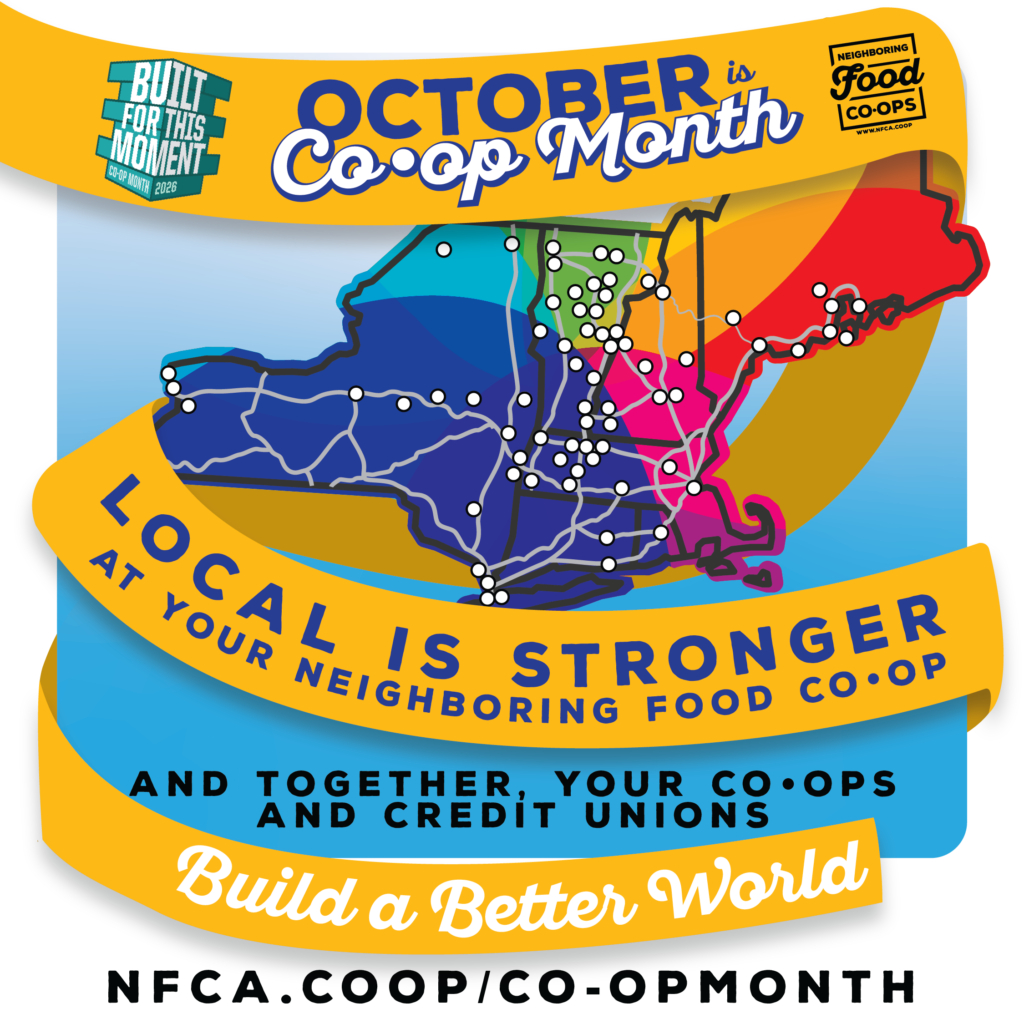
You can also look for your local edition of Edible Magazine, hitting newsstands this fall, where you’ll find our special Co-op Month ad in collaboration with Cabot Creamery Co-op and nearly 70 co-operatives and credit unions from your community and across the Northeast.
Visit our website to learn more about Co-op Month and how co-ops and credit unions enable people to Build a Build a Better World, together.
Farm Stay Giveaway!
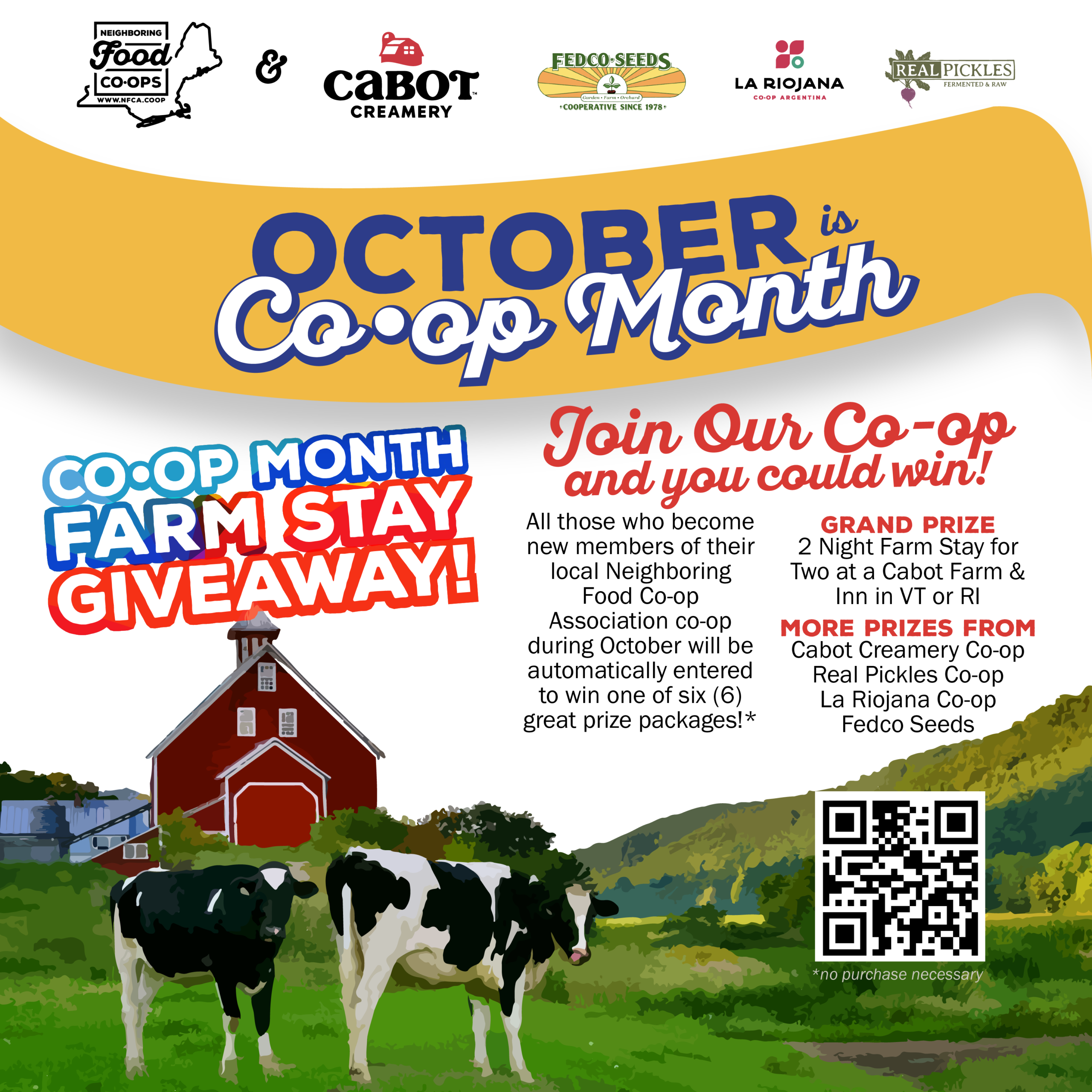
Join your local food co-op during Co-op Month and be entered to win one a six great prize packages!*
Neighboring Food Co-op Association member co-ops: Share this graphic in your e-news and social media during the month of October. Spread the word, grow your membership, and support our Co-op Month partners!
Visit our website more information including downloadable posters, newsletter stories, and other Co-op Month Resources.
*no purchase necessary
.Coop Member Benefit
Co-op Month is a great time for your co-op to promote its online Co-operative Identity. Thanks to our new partnership with DotCooperation, it’s easier than ever.
A .coop domain is more than an internet address. It immediately identifies your organization as part of the international co-operative movement based on our shared Values and Principles. Through our new partnership with DotCooperation, Neighboring Food Co-op Association members can receive a range of benefits including discounts and technical support.
- Already have a .coop domain? Check out available discounts in renewals and the opportunity to obtain additional valuable domain names.
- Considering switching to .coop? Get you first year free, a discount on renewals, and technical support for switching over.
Why give your hard-earned money to big tech? DotCoop is owned by the co-operative movement. And unlike a .com or other domain, your .coop registration stays in the co-operative economy, enabling DotCoop to support:
- Local and global events that promote co-operatives.
- Efforts to build digital partnerships in the global south.
- Visibility projects like stories.coop and worldmap.coop (which are 100% supported by .coop users!).
- Safeguarding the only co-op exclusive part of the internet.
By using a .coop domain, your organization becomes a partner in the global co-operative movement. It’s Principle 6 in action!
For more information on our member benefit with DotCoop, please visit our partnership webpage.
Co-op Language Matters

“Language and metrics are not neutral. If we use the language of capital-based business, we also adopt its values and principles. We must have the ambition to build our own managerial language guided by our Principles.”
This was Giuseppe Guerini, President of Cooperatives Europe and Vice President of the International Cooperative Alliance (ICA), speaking at the Workshop on Cooperative Law & Public Policy in Pula, Croatia, in August. The event, presented by the ICA and the International Centre for Co-operative Management (ICCM) at Saint Mary’s University, brought together co-operative leaders, researchers, and attorneys to explore the Statement on the Cooperative Identity in the context of global challenges and opportunities to grow our movement.
Thematic presentations and dialogs were conducted through the lens of the ICA’s Guidance Notes to the Co-operative Principles and included topics related to sustainability, global peace, capital, tax treatment, and the definition of membership. All these issues, and more, were then explored more deeply in a weeklong “Co-operative Law Summer School,” led by Professor Hagen Henrÿ, chair of the ICA’s Co-operative Law Committee, and focused on the relationship between the Co‑operative Identity and the concept of sustainable development.
The sessions were timely and reminded me of an article I had written in 2018 for Green Living magazine, reflecting on my experience as a lecturer with the Department of Economics at the University of Massachusetts, Amherst. Over the years, I found that discussion during the first few weeks of my class, “Introduction to the Co-operative Movement,” often revolved around clarification of a few basic terms: A co-operative is a business, so why were we talking about “members”? Aren’t enterprises owned by entrepreneurs, investors, or shareholders? If the profit motive is the primary engine of our economy, what is “surplus”? What is “patronage” — and why does it matter?
In developing my course, I had come across a pamphlet entitled, Learning the Language for Study and Action. Originally published in 1940 by the Cooperative League of the USA (now known as U.S. Co-ops) and revised in 1971, the publication is surprisingly relevant today: “Business mergers are widespread; economic power is highly concentrated,” the authors note. “Can we really have much free enterprise in our country if the average citizen doesn’t know what’s going on?”
Co-ops began as a grassroots movement focused on building business literacy and empowering working people facing social, economic, and political disruptions. In keeping with this history, education remains a basic principle of the ICA’s Statement on the Co-operative Identity, which affirms that co-ops must work to “inform the general public — particularly young people and opinion leaders — about the nature and benefits of co-operation.”
Today, the co-op business model is enshrined in international law and state statutes, providing a legal framework that enables people from all walks of life to work together to meet their “economic, social and cultural needs and aspirations through a jointly owned and democratically-controlled enterprise.” From farmer co-ops to food co-ops, worker co-ops to credit unions, housing co-ops to artisan co-ops, there are an estimated 65,000 co-operatives in the U.S., with 1 in 3 Americans being a member of at least one co-op.
Despite their influence, co-ops continue to face the basic challenge that young people do not generally learn about co-operative enterprise in our schools, colleges, and universities — much less our business schools. As a result, this education falls to our movement and must begin with the basic terms we use to describe our businesses and how they operate. Of course, this is also an opportunity: Just as learning a new language offers new ways of seeing the world around us, the words that we use shape our perceptions of economics and the possibilities available to us to create change.
For example, co-op membership usually involves the subscription of a share in the business, like other corporations. But this capital contribution is secondary to being actively using the products and services of the enterprise. That is, before one can become an “owner” of a co-operative, you must first be eligible to “use” it to meet your needs as a consumer, producer, or worker. This relationship comes before and is superior to that of capital, in contrast to investor-owned businesses. As stated in the Guidance Notes, “in a co-operative capital is the servant, not the master of the enterprise.”
It can be difficult to communicate the character of membership in a co-operative as one of both usership and joint ownership, but you cannot have one without the other. Further, it is important to recognize that the subscription of a member share is not an investment in the conventional sense because it doesn’t anticipate a financial return. Rather, in the words of the Co-operative Identity, it is a “contribution” of capital supporting the ability of the business the meet the collective needs of its members.
Holding a member share does not give an individual property rights that can be sold, or any individual control over the business as a sole proprietor has. Rather, it confers on the holder specific obligations to use the business, related benefits such products, services, or employment, and the right to participation democratic governance. “In essence, membership means that there should be a special relationship between the co-operative and the people whose needs it is established to serve,” reads the ICA’s Guidance Notes. “Cooperatives are user-driven organizations… established by, owned by and operating to meet their members’ common economic, social and cultural needs and aspirations.”
Co-ops and credit unions are often described as not-for-profit enterprises, as opposed to for-profit or non-profit, in that they are designed to operate at cost, generating sufficient margins to meet member needs rather than maximizing returns for investors. (Some co-ops may have investors but they have no vote in the business, and their financial return is limited.) It is not that co-operatives should not be “profitable,” meaning that income should be greater than expenses. This is necessary for any business to be viable. The question is how we describe these resources and what they will be used for.
In a co-operative, the difference between income and expenses from business done with members is described as surplus, as opposed to profit. Why not use conventional business term? The authors of Learning the Language argue that the words that we choose are an opportunity to help “educate members and the public to understand co-op principles and objectives.” Surplus, they point out, is “not true profit, to be paid to the absentee owners of invested capital. In a co-operative, it is ‘savings’ to be returned to active user-owners, in proportion to their use of the business — or used to strengthen their co-operative.” (This is why co-operatives are treated differently under tax codes – but that is a matter for another article.). As Professor Hagen Henrÿ points out in the ILO’s Guidelines for Cooperative Legislation, co-operatives should therefore distinguish between profit (the positive financial results from business done with non-members) and surplus (those derived from transactions with members). “According to the strict cooperative principles, profit will be transferred to an indivisible reserve fund; surplus should be distributed among the members, at least in part, in proportion to their transactions with the cooperative over a specified period of time.”
In contrast to an investor-owned business, in which profits are distributed based on how much capital one owns, a co-op may return a portion of its surplus to it members on the basis of their “patronage,” or use of its products and services. In a consumer co-op, this means a member’s purchases; in a producer co-op, the amount of product processed and marketed through the business; and in a worker co-op, the labor contributed to the business. To make things even more interesting, “multistakeholder” co-ops can have a variety of member types with different “user” relationships to the enterprise.
As mentioned above, a member share in a co-operative is not an investment as it does not entitle the member to a financial return. Rather, as “users” of their shared enterprise, members receive an economic return in the form of desired products, services, or employment. They also receive social returns such as stronger communities, sustainable food systems, and more stable local economies, in keeping with the policies that they approve.
Language matters, demonstrated by the fact that in many jurisdictions, it is illegal to include the term “co-operative” in the name of a business unless it is incorporated as such and operates in keeping with internationally recognized principles. The words we use can also play a powerful role in enabling people to envision the possibility of a more just, sustainable, and inclusive economy, particularly at challenging times such as these.“How can we restore democratic control over American business if the people themselves do not understand business?” the authors ask in Learning the Language. “We need millions of Americans who understand corporate business. And where can an American gain better training than belong to a co-operative…? Indeed, it’s almost the only way many Americans ever get a practical business education.”
Erbin Crowell is Executive Director of the Neighboring Food Co-op Association, serves on the Board of Directors of U.S. Co-ops, and is an adjunct professor at Saint Mary’s University.
Voter Registration Day Activities

With midterm elections on the horizon, over three and a half thousand National Voter Registration Day Community Partners — including our food co-ops — stepped up to engage their communities in their democracy on September 15th.
Food co-ops across region took the opportunity to connect with members and shoppers, bringing the attention to the importance of voting, upholding democracy and civic engagement. For example, Blue Hill Food Co-op (ME) held day-long activities organizing a Democracy Day with tabling by the League of Women Voters who helped folks register to vote throughout the day, speakers, music, and a rank choice “Peace Pie” making contest, while Franklin Community Co-op (MA) had in-store voter registration table staffed by Jillian Lang, Community Outreach and Education Coordinator.

“In a moment when division can feel overwhelming, our partners proved that unity and joy are possible when we commit to strengthening democracy together,” said Chyann Sapp, Campaign Director of National Voter Registration Day.
Participation in National Voter Registration Day also contributes to the Co-ops for 2030 Campaign, the international co-operative movement’s efforts to support the United Nations Sustainable Development Goals (SDGs), and specifically SDG 16, “Peace, Justice & Strong Institutions,” which calls on the U.S. and nations around the world to work together to build effective, accountable and inclusive institutions at all levels.
For more information in the NFCA’s policy advocacy efforts, please visit our website.
Fare Share Co-op’s 50 Years

Neighboring Food Co-op Association member Fare Share Food Co-op is celebrating its 50th anniversary with an exhibit at The Matolcsy Art Center in Norway, Maine.
“Our Story: Fare Share Food Cooperative 1976-2026” – An exhibit of ephemera, voices, and chronology, compiled by local author, poet, and long-time member Lisa Moore, the co-op’s 50 years. Everyone is invited to the Opening reception Friday, October 2nd, 6 to 8 p.m. Moore will be on hand to answer questions and share stories about the project and signed and numbered copies of Our Story will be available for purchase.
“The gallery will be full of ephemera: it will look like a room-size mosaic in there!” posted Lisa Moore. “[It’s] not your usual art show at all.”
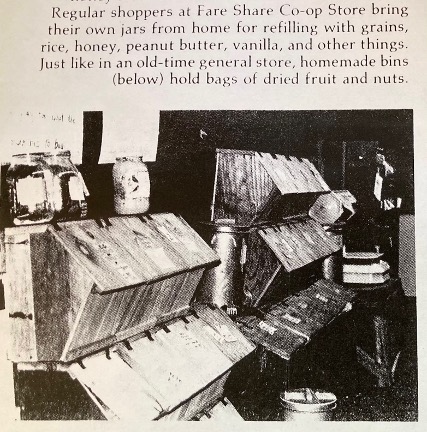
For 50 years, Fare Share Food Co-op has been part of the fabric of the Norway community, providing local residents with a place to shop, gather, and support the co-operative tradition of consumer ownership. The exhibit offers an opportunity to look back at the people, ideas, challenges, and accomplishments that have shaped Fare Share over five decades.
Over the years, the co-op has evolved along with Norway and the surrounding area, remaining rooted in the principles of co-operation, community, and local participation. Generations of members, employees, volunteers, and shoppers have contributed to its story.Long-time members and shoppers, those discovering the co-op for the first time or visiting the area, all are invited to celebrate 50 years of community history!
Please join us in congratulating Fare Share Food Co-op on their incredible decades building their community, strengthening the regional food system, and growing the wider co-operative economy. For more information, visit Fare Share Food Co-op.
Co-ops in the News
… and don’t forget to check out our Co-op Month Ad Campaign, beginning with the Fall Edition of Edible Magazines!
Has your co-op been in the news recently? Send your item to info@nfca.coop.
October Cave-to-Co-op Special

This month’s Cave to Co-op cheese is Swallow Tail Tomme from Stony Pond Farm, Fairfield, VT
Each month, your Neighboring Food Co-ops feature our region’s artisan cheesemakers by offering a specially selected cheese at great price. Look for the “Cave to Co-op” sign in the cheese section at your local food co-op. To find one near you, visit www.nfca.coop/members.
Made by cheesemaker Melanie Webb at Stony Pond Farm in Fairfield, Vermont, Swallow Tail Tomme is a raw-milk, French farmhouse-inspired cheese made in small batches with milk from the farm’s own Jersey cows. The cows head out to pasture each spring, and Swallow Tail was created to capture that seasonal connection between the herd, the grass, and the wider farm ecosystem. Creamy and buttery with a fresh, lively character, the 2026 wheels are tasting beautifully right now. Melanie describes this year’s Swallow Tail as “spring encapsulated” how’s that for a way to savor the sunshine as we head into autumn!
Stony Pond Farm is a family-owned, certified organic farm stewarded by Tyler and Melanie Webb. Their cattle are rotationally grazed on nutrient-rich organic pasture, and their farmstead cheeses are made with milk from their own herd. Swallow Tail is aged in the farm’s cave for at least 60 days, with the current wheels around 80–90 days old. It’s a wonderful example of how pasture, season, animals and cheesemaking can all come together in one cheese.
Swallow Tail pairs well with crisp apples, ripe pears, local honey, fresh apple cider, crusty sourdough, roasted winter squash, sautéed mushrooms, dry hard cider, and light-bodied red wines. Try this lovely cheese in an apple and cheese grilled cheese or mushroom tart, in potato, leek and cheese gratin or with cider-braised cabbage with melted Swallow Tail. Use it with a fall vegetable frittata or roasted delicata squash with shaved cheese.Stony Pond Farm is also a Northeast Organic Family Farm Partnership (NOFFP) Brand Partner and you can view a presentation by Melanie during our NFCA Peer Dialog from earlier this year: https://www.youtube.com/watch?v=Tcy5z4DH6yY
Working together, the NFCA is leveraging the purchasing power or our food co-ops to support local producers. Each month, we work in collaboration with Provisions International to feature a specially selected local cheese at great price. Look for the “Cave to Co-op” sign in the cheese section at your participating food co-op.
Farmers Bring Their Priorities to DC
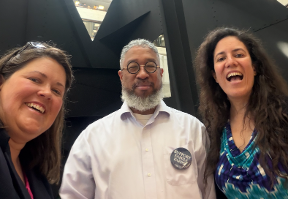
New England Farmers Union members traveled to Washington, D.C., September 14–16 to discuss the pressures facing the region’s farmers and consumers and the federal policies that could help.
By Ella Kennen, New England Farmers Union
New England Farmers Union (NEFU) Vice President Mary Castonguay of Maine joined board member Ella Kennen and member Robert Chang, both from Connecticut, for National Farmers Union’s (NFU) annual Legislative Fly-In. The visit began Monday with briefings for Farmers Union members from across the country. NFU staff described a difficult farm economy, drawing comparisons to the pressures of the 1980s farm crisis and its lasting consequences for farm families and rural communities.
At USDA headquarters, participants heard from the Office of the Chief Economist and the Federal Trade Commission, including an update on the John Deere right-to-repair settlement. Richard Fordyce, USDA Under Secretary for Farm Production and Conservation, discussed “One Farmer, One File,” an initiative intended to reduce duplicate paperwork and improve coordination across USDA agencies, including the Farm Service Agency and Natural Resources Conservation Service.
Monday afternoon’s Capitol Hill briefing turned to trade, competition, and the Farm Bill. Lori Wallach, director of Rethink Trade, discussed international trade and its consequences for farmers. A panel of experts from the American Economic Liberties Project explored connections between corporate concentration in agriculture and other sectors.
Members of Congress also addressed the assembled farmers that afternoon. Representative Shontel Brown of Ohio outlined her priorities for an inclusive, responsive Farm Bill. Representative Frank Lucas of Oklahoma pointed to leasing land as one way established farmers can help the next generation get started. Senator Amy Klobuchar, the Senate Agriculture Committee’s ranking member, expressed hope for progress on a new Farm Bill.
On Tuesday and Wednesday, Mary, Ella, and Robert conducted whirlwind meetings with lawmakers and staff from 13 congressional offices representing Connecticut, Maine, Massachusetts, New Hampshire, and Vermont. They brought Farmers Union priorities into conversations about the needs of New England farmers and consumers, including restoring mandatory country-of-origin labeling, funding local food purchasing, food security, investing in NRCS conservation programs, and improving dairy farmers’ viability. Legislators were thanked for their support of co-ops in their districts and encouraged to participate in the bipartisan Congressional Cooperative Business Caucus.
The group reported broad agreement in those meetings that farm policy must address the needs of both producers and consumers, including support for reversing cuts to SNAP. High input costs and USDA staffing cuts were also recurring concerns.
As visits wrapped up on Wednesday, the Senate Agriculture Committee advanced its Farm Bill on a 12–11 party-line vote. The vote moved the legislation out of committee, but disagreements over nutrition policy remained unresolved.
With midterm elections approaching, the conversations offered few firm answers about what Congress would accomplish in the coming months. However, they did give NEFU members a clearer understanding of the offices’ priorities and an opportunity to explain how federal decisions affect farms in the region.
For NEFU, the work continues after the fly-in. We’ll stay in touch with congressional offices as programs and legislation change, sharing what we’re hearing from farmers and following up on practical ways to address the issues they’re facing.

And you can help! For as little as $15, you can become a “Friend of the Farmer,” supporting Robert, Mary, and Ella in DC and strengthening the voice of our region’s farmers and consumers before our policy makers.
For more than a decade, the Neighboring Food Co-op Association (NFCA) has partnered with the New England Farmers Union to build a more healthy, just, and sustainable food system for everyone. There is strength in numbers, and more than ever we need you. For more information on the benefits of membership, please visit the New England Farmers Union website.
Upcoming Events

International Credit Union Day on October 15 is an opportunity for co-ops and credit unions to work together to spread the word about the difference they make in their communities every day.