
Was this newsletter forwarded to you? Subscribe here to keep up to date on NFCA News!
In this edition:
Please Feel Free to republish these Stories in your Co-op or Organization’s Newsletter or Blog, or Link to them in Social Media, crediting ‘Neighboring Food Co-op Association’ and linking to our website at https://nfca.coop.
Governors Proclaim Co-op Month!

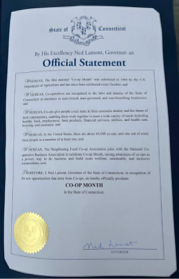
Every October, the Neighboring Food Co-op Association partners with State Governors across the Northeast to proclaim Co-op Month, a national celebration that began in 1964 with the U.S. Department of Agriculture.
This year, Governors Ned Lamont of Connecticut, Maura Healey of Massachusetts, and Kelly Ayotte of New Hampshire issued official proclamations in their states, noting that co-operatives enable people “to work together to meet a wide variety of needs, goals and aspirations including healthy food, employment, farm products, financial services, electric, telephone and cable services, and health care, housing, and insurance.” Rather than being owned by investors, co-ops and credit unions are governed by their members, the people who use them to meet their shared needs and goals.
The theme for this year’s Co-op Month, “Built for this Moment,” was chosen by U.S. Co-ops (formerly the National Cooperative Business Association) to raise awareness of co-operatives as a proven way to do business and build resilient, sustainable, and inclusive communities.
“Connecticut residents know the difference that co-ops make every day,” said Cassandra Campbell, President of the Neighboring Food Co-op Association (NFCA) and Vice President of Fiddleheads Food Co-op in New London. Campbell noted that in addition to Fiddleheads, Willimantic Food Co-op has been active for more than 50 years, and there are efforts to create new food co-ops in the state, including Farmington River Food Co-op in New Hartford, and North End Co-op Market in Waterbury.
Connecticut is also home to many housing co-ops, member of farmer co-operatives, worker co-ops, and numerous credit unions.
“We are grateful to Governor Lamont for recognizing the important role co-operatives, including credit unions, play in strengthening Connecticut’s communities and economy,” said John Holt, Board Chair of Connecticut’s Credit Unions and CEO of Nutmeg State Financial Credit Union. “As financial co-operatives, credit unions are built on the principle of people helping people, and through our collaboration with the Neighboring Food Co-op Association, we are proud to demonstrate how co-operatives across sectors can work together to expand opportunities, strengthen communities, and improve the lives of those we serve.”
Chris Whiton, a member of the NFCA Board of Directors and Operations Manager at Littleton Food Co-op, noted that “about 61,000 people are members of New Hampshire’s five food co-ops, which are engines of the local economy, generating $140 million in revenue and employing about 600 people.”
And in Massachusetts, Caitlin von Schmidt, Brand and Membership Experience Coordinator at Franklin Community Co-op, noted plans for expansion at her co-op, which operates locations in Greenfield and Shelburne Falls, and the efforts to launch new co-ops in the region such as Charles River Food Co-op in Watertown, at the other end of the state.
“Co-op Month is an opportunity to celebrate a movement that brings people and organizations together around a shared commitment to strengthening communities and improving lives,” said Ron McLean, President and CEO of the Cooperative Credit Union Association, which represents credit unions in Massachusetts, New Hampshire, and Rhode Island. “Through collaboration across sectors, we can extend our collective impact and create meaningful, lasting change in the communities we serve.”
“Co-op Month is an opportunity to celebrate a movement that brings people and organizations together around a shared commitment to strengthening communities and improving lives,” said Ron McLean, President and CEO of the Cooperative Credit Union Association, which represents credit unions in Massachusetts, New Hampshire, and Rhode Island. “Through collaboration across sectors, we can extend our collective impact and create meaningful, lasting change in the communities we serve.”
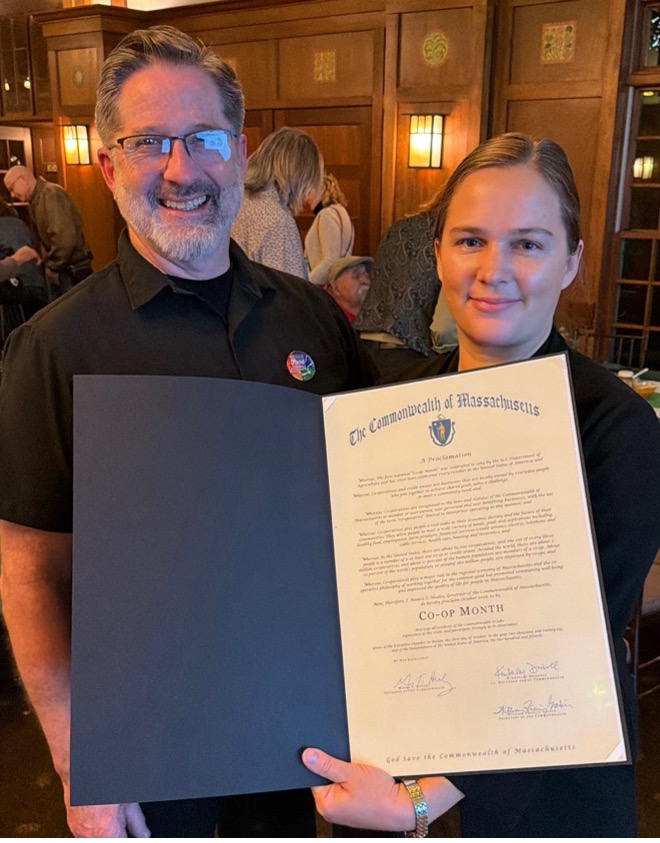
The Governors’ proclamations invited residents to join in the Co-op Month celebrations and learn more about the co-operatives and credit unions that are part of our communities. As part of the effort, the NFCA invited people to visit one of the 65 food co-ops in the Northeast — and then look for the “Go Co-op” and “Co-op Trade” signs on the shelves that identify co-op made products. From dairy products from Cabot Creamery and Organic Valley, fresh produce from Deep Root Organic Co-op to fairly traded coffee from Dean’s Beans and Equal Exchange, La Riojana wines to naturally fermented vegetables from Real Pickles, the co-operative economy is all around us!

For more information about Co-op Month, please visit https://nfca.coop/Co-opMonth.
Share this story on social media or your e-news!
[Sassy_Social_Share type=”standard” url=”https://nfca.coop/0962″]
Spreading the Word

During Co-op Month, the Neighboring Food Co-op Association worked with our friends at Cabot Creamery Co-op and almost 70 other co-operatives and credit unions to spread the word in communities across the Northeast: Co-ops Build a Better World!
Celebrated every October, Co-op Month is a unique opportunity to engage consumers, policymakers, and activists about what makes co-operatives different and why they should choose to “Go Co-op” when they shop, choose products and services, create a new business or convert an existing one. This year, the Neighboring Food Co-op Association decided to expand on our commitment to increasing awareness of the co-operative economy by placing full page ads in every local edition of Edible Magazine where we had member co-ops with the message, Local is Stronger at Your Neighboring Food Co-op… and Together, Your Co-ops and Credit Unions Build a Better World.
Working with our friends at Cabot Creamery Co-op, we invited food co-ops, co-operative businesses, and credit unions across the Northeast to join in, placing their logos in local editions and helping communicate our shared impact. All told, we placed ads in 14 local editions of a magazine that celebrates local food and culture, and reaching an estimated readership of 930K conscientious consumer through the print editions alone.

In addition to these ads, we were also pleased to work with the Berkshire and Pioneer Valley editions of Edible to publish interviews with our Executive Director, Erbin Crowell, who spoke to how co-ops help build a sustainable economy:
“When you consciously shop at a food co-op, you’re using your purchasing power to create something different. You’re joining with your neighbors to increase food security, to grow the market for local producers, sustain local jobs, strengthen the infrastructure of your community, provide a meeting space” for your neighbors, etc.
And in Green Energy Times, which is distributed free across much of our region, we were able to shine a light on “Cultures of Co-operation,” building on the theme for this year’s Co-op Month:
“As we face new challenges to global peace and environmental sustainability, it is useful to recall models that have helped us in the past and consider how they might be adapted to the present… As businesses that are democratically governed by the people who actively use them to meet their shared needs, co-ops offer an alternative vision for a more inclusive and sustainable economy that puts people and our collective future first. In short, co-ops were built for this moment.”
Co-op Month is cause for celebration and collaboration, and we were particularly pleased to be invited to present on our experience as a regional association to a group of food co-ops in California as they considered how they might work together to build relationships, strengthen public awareness, and support shared success.
Together, the members of the NFCA are working with other co-ops and credit unions to build awareness of the difference that co-ops make every day. To check out our ads and some of the articles mentioned above, please visit https://nfca.coop/Co-opMonth.
Intern Reflections: Mapping Co-ops

This summer, Neighboring Food Co-op Association intern Christopher Calisi from the University of Massachusetts, Amherst, researched co-ops and credit unions in our region to help further develop DotCoop’s Cooperative World Map.
Over the summer months, I worked with the Neighboring Food Co-ops Association (NFCA) through UMass, Amherst. The specific market research I performed was centered on mapping opportunities for cross sector collaboration in New York and New England. The goal of this research was to expand cooperation for the cooperative movement and to work with an organization to further learn about cooperatives and their approach towards community impact.
I developed a strategy for collecting and verifying co-operative data. I gathered data on co-op names, purposes, and addresses, from resources such as the NFCA website, individual co-op website, and the U.S. Federation of Worker Co-ops. With this information, I searched for each co-op on the .coop World Map, which is an up-to-date worldwide map designed to highlight every cooperative. The research I did for the NFCA helps identify underrepresented co-ops, which will make it easier for them to connect with the co-operative movement. I checked every organization I investigated to see how they were legally registered.
This experience strengthened my ideas on what co-operation means for coops and how it is an impactful strategy to expand community involvement and development. A co-operative enterprise needs to take advantage of the principle “cooperation among cooperatives” to be successful. From participating in NFCA-hosted webinars and finding smaller co-ops, I witnessed firsthand how co-operation is an integral part of the co-op experience.
The .coop map is filled with 10s of thousands of co-operatives globally. In the northeast, over 1.6 thousand co-ops are present. Through a webinar I attended about the Mondragón Cooperative Experience hosted by NFCA Executive Director Erbin Crowell, I learned there have been 92 co-operatives created from the Mondragon movement with over 70,000 employees and over 1.3 million consumer members. These numbers point to the idea that the co-operative movement creates other co-ops. I’m going to define this as the “Mondragon Effect”, which is that a co-op’s mere existence acts as a basis for other co-ops forming in the vicinity, increasing co-operation and widening the web of the co-operative movement. If a single co-op can act as a catalyst for so many co-operative forming, the New York/ New England areas could also see a similar outcome through a strong network and a co-op (like Mondragón) that they can organize around.
With my research, I hope a wider net can be cast around the New England and New York co-op area. My goal from the beginning of my time with the NFCA was to grow representation and cross sector collaboration, and I believe it will be used to do that. What I gathered will be utilized for advertisements, such as Edible Magazine, to show that co-ops and credit unions are all over each community. [SSC1] This is just one of many ways I believe my research will be used, and it started with improving collaboration and the .coop map.
For more information on DotCoop and our member benefit, please visit our partnership webpage.
Peer Dialogs

Co-ops across the Northeast established the Neighboring Food Co-op Association (NFCA) with the goal of providing members with opportunities for peer-to-peer networking, collaboration, and innovation, enabling staff and directors to build stronger relationships and support shared business success.
To date this year, the NFCA has hosted more than 30 Dialogs for our member co-ops, including our quarterly Peer Group for Bulk Departments which met most recently in October. In between the laughter and camaraderie, participants shared ideas on sourcing and distributors, sustainable packaging options, and seasonal variations in product sales. The dialogs add value for both experienced department buyers and newer staff, providing opportunities for relationship building, mutual support, and peer to peer collaboration.
“The Bulk Peer Dialogs have been super helpful. We don’t have specific bulk expertise on our staff, so gaining knowledge and norms from the group has been critical,” noted a recent participant.
Another example of our Peer Dialogs this year has been “Meet the Producer” sessions as part of our efforts to strengthen consumer demand for our organic dairy farmers in collaboration with the Northeast Organic Family Farm Partnership (NOFFP). Coming up this month, the NFCA is inviting staff from member co-ops to meet two Northeast ice cream producers to learn about their farms, practices and products, and why being an organic dairy is important to them. This free event is a unique opportunity for food co-op managers, frozen and dairy buyers, merchandizers, marketing and customer service staff to meet producers from Strafford Creamery in Strafford, VT, and Wilson Farm in Greensboro, VT.
The dialog, hosted by the NFCA and NOFFP, will take place online, Friday, November 6, 2026, at 1:00 PM. Member co-ops are invited to register ahead of time at this LINK.
To ensure that these dialogs add value for our member co-ops, we recently surveyed participants to ask out what they find most useful in these opportunities:
- “[It’s] great to hear directly from the cheesemakers, this will help me market their product better. The level of care that goes into the cheese [making] is phenomenal.” –Outreach Staff
- “Co-op relationship building, hearing issues that other co-ops are dealing with, and especially where overlap with our co-op issues, and gaining insights and networking connections.” – Board Member
- “I also participate in [other organizations’] peer sessions from time to time, and I find the NFCA sessions even more valuable. They are extremely well facilitated.” – General Manager
- “I really like the small co-op sessions because our challenges (i.e. survival) are so different from those of better resourced co-ops. Thank you for what you do!” – Board President of a Small Food Co-op
- “I really enjoy hearing from other co-ops and it’s helpful to hear how others work within their communities.” – Board Member
- “Learning different marketing strategies and techniques of other [buyers].” — Department Buyer
- “I truly appreciate the outreach that the NFCA is making to connect the various departments and boards of our co-ops. It is truly helpful to hear what other co-ops are experiencing.” – Board President
NFCA Peer Dialogs are free to our member co-ops and are organized based on feedback on their needs and priorities. Current online groups include for Board Leaders, Bulk Departments, General & Senior Managers, and Small Food Co-ops, topical discussions on such as the Northeast Organic Family Farm Partnership (NOFFP), Co-op Month, Staff and Community Safety. Special presentations in 2026 have included the Business Advantage of Co-operative Values, participation in the New England Feeding New England Local Food Count, and the Mondragón Co-operative Experience.
Upcoming sessions in 2026 include:
- NFCA Peer Dialog for Board Leaders
Nov 05 — 6:30-7:30 PM — Online - NFCA & NOFFP Meet the Producers
Nov 06 — 1:00-2:00 PM — Online
For more information on participating in NFCA’s Peer Dialogs, please e-mail info@nfca.coop. For upcoming sessions and other events, please see our online calendar.
Upper Valley Co-op’s 50 Years

Neighboring Food Co-op Association (NFCA) member Upper Valley Food Co-op is celebrating its 50th anniversary this year!
With 50 years under its belt, the Upper Valley Food Co-op located in White River Junction, VT, has changed locations but they are proud to be able to say their core values have not. The heart of the co-op’s mission is to offer the community organic, local, and fairly-traded goods has been the same since the beginning. They also strive to educate consumers about food and nutrition, food safety issues, and network with other co-operative businesses regionally to encourage an economic environment that benefits all. The Upper Valley Food Co-op is a founding member of the NFCA and its leadership contributed to the formation of our regional association.
The co-op will be celebrating their 50th year at their Annual Meeting on November 7th with live music, family-friendly activities, a panel of speakers who have contributed to the co-op’s mission throughout the years, and a shared meal.
“We [continue to] see a steady supply of new members, and our buyers bring new products to the shelves, always in keeping with product selection guidelines that let shoppers purchase with confidence. Each department emphasizes local vendors when possible, and our community donations help local organizations, thanks to generous shoppers. We are in a strong financial position as we celebrate our 50th year in business,” reports Tina Barney, Upper Valley Food Co-op’s Board President. “As I prepare to pass the President’s mantle to another skilled and energetic Board member, I am confident that UVFC will continue to serve the Upper Valley community well.”
For 50 years, the Upper Valley Food Co-op (VT), has been part of the fabric of their community, providing local residents with a place to shop, gather, and support the co-operative tradition of consumer ownership.
Please join us in congratulating the Upper Valley Food Co-op on their decades building their community, strengthening the regional food system, and growing the wider co-operative economy. For more information, visit their website.
Co-ops in the News
$16.6M coming to Franklin County through Community One Stop for Growth grants
Greenfield Recorder

… and don’t forget to check out our Co-op Month Ad Campaign, beginning with the Fall Edition of Edible Magazines!
Has your co-op been in the news recently? Send your item to info@nfca.coop.
November Cave-to-Co-op Special

This month’s Cave to Co-op cheese is Madison from Green Mountain Blue Cheese, Highgate, VT
Each month, your Neighboring Food Co-ops feature our region’s artisan cheesemakers by offering a specially selected cheese at great price. Look for the “Cave to Co-op” sign in the cheese section at your local food co-op. To find one near you, visit www.nfca.coop/members.
Green Mountain Blue Cheese grew out of the Boucher family’s dairy farm in Highgate, Vermont, where cheesemaking has been part of the farm’s story for more than 25 years. Today, Kayleigh Boucher, Dawn Morin-Boucher’s niece, has taken over cheesemaking on the family farm, carrying the tradition forward. With deep Vermont farming roots and a hands-on approach to cheesemaking, Green Mountain Blue continues to craft distinctive blues that reflect the character of the farm.
Don’t be blue when it comes to blue cheese! Madison is a farmhouse-style blue unique to Green Mountain Blue, aged longer than the creamery’s other cheeses to develop deep, complex, tangy flavors and crunchy cheese crystals. Its dense, fudgy texture, firmer finish and hints of Parmesan make it a standout on the cheese counter and in the kitchen. Madison took first place in its category at the 2026 American Cheese Society Awards. It’s a perfect addition to a Thanksgiving cheese plate and a Vermont blue to enjoy during the holidays and all year long!
For recipe ideas try a garlic, caramelized onion & Madison Blue pizza, Madison Blue mac and cheese or steak with Madison Blue compound butter. This blue cheese pairs well pears, figs, roasted brussels sprouts and toasted hazelnuts. Try with dried apricots and raisins, local honey, whole-grain crackers, almonds, walnuts & hazelnuts. Beverages including a tawny port, Riesling, dry cider, amber ale and Cabernet Franc. Check out this recipe with peaches!
Peach and Madison Toasts
- 2 large ripe peaches
- 2 tablespoons fresh lemon juice
- 2 teaspoons honey
- 4 slices country-style bread
- 6 tablespoons olive oil, divided
- Kosher salt
- 4 ounces Madison, room temperature
- 2 cups (loosely packed) trimmed purslane or baby arugula
- Freshly ground black pepper
Preparation
- Using the tip of a paring knife, score an X in the bottom of each peach. Cook in a large saucepan of boiling water just until skins begin to peel back where cut, about 1 minute. Using a slotted spoon, transfer to a bowl of ice water; let cool. Peel; cut over a small bowl into wedges, collecting juices. Add lemon juice and honey and toss to combine.
- Toast bread, brush with 2 Tbsp. oil, and season with salt. Spread cheese on toast and top with peaches, leaving juices behind. Whisk 4 Tbsp. oil into juices. Toss purslane with enough dressing to lightly coat in a bowl; season with salt and pepper. Arrange over toasts.
Working together, the NFCA is leveraging the purchasing power or our food co-ops to support local producers. Each month, we work in collaboration with Provisions International to feature a specially selected local cheese at great price. Look for the “Cave to Co-op” sign in the cheese section at your participating food co-op.
The Urgency of Advocacy

With a new Congress on the horizon, it is critical that we lay the foundation now to advocate for policies supporting a more just, inclusive, and sustainable food system and economy in the coming year — and you can help!
The past two years have been particularly challenging and disruptive for family farmers, communities, and our co-operative movement. Still, we have worked with our partners to engage policymakers in defending food security, combating climate change, promoting co-operative development, and strengthening our democracy. Over the past year, we have worked to defend SNAP benefits, testified before the Senate Committee on Small Business on the important role of co-ops in our communities, and visited the offices of legislators from across the Northeast. It has not been easy, as we have faced gridlock in Congress and limited opportunities to create change. However, we know that it is critical that we stay engaged, strengthening partnerships, developing relationships with policymakers, and finding common cause.
There is strength in numbers, and one easy way you can help is by joining the New England Farmers Union, today! Family Farmers are the heart of the Farmers Union — and consumers are also invited to join as a “Friend of the Farmer” for just $15! Businesses or organizations can also join, and NFCA Member Co-ops can sign up at a special discounted rate of $100.
Your membership will help us advocate for a better food and farm system in the Northeast, joining the voices of producers, consumers, businesses, and co-operatives from across our region to lobby decision-makers on a range of issues important to our region including…
- Support Food Security. We advocate for local producers that need access to markets and consumers who must be able to access affordable, healthy, nutritious food.
- Strengthen Rural Communities. We need reinvestment in our rural hospitals and mental health resources, improved broadband connectivity in rural areas, and repairs to the damage done to our postal service.
- Fight Consolidation of our Food System. Our regional producers and processors need more direct access to markets, greater transparency from buyers, and more stable prices for dairy and other farm commodities.
- Combat Climate Change. Farmers need the resources, technology, and information necessary adapt to climate change – and a seat at the table and a strong voice in the development of climate policies and programs.
- Grow Our Co-ops. Working together, we will recruit more representatives to the Congressional Cooperative Business Caucus, protect and promote our business model, and advocate for policies that will help our co-ops grow.
These efforts are vital for the future of our regional food system. But we need you to strengthen our voice. Please join us now, encourage your friends and family to join, and look for opportunities for advocacy in the coming months.
For more than a decade, the Neighboring Food Co-op Association (NFCA) has partnered with the New England Farmers Union (NEFU) to build a more healthy, just, and sustainable food system for everyone. NEFU is the regional chapter of the National Farmers Union, which advocates on behalf of nearly 200,000 American farm families and their communities and envisions a world in which farm families and their communities are respected, valued, and enjoy economic prosperity and social justice.

And you can help! For as little as $15, you can become a “Friend of the Farmer,” strengthening the voice of our region’s farmers and consumers before our policy makers in DC.
For more than a decade, the Neighboring Food Co-op Association (NFCA) has partnered with the New England Farmers Union to build a more healthy, just, and sustainable food system for everyone. There is strength in numbers, and more than ever we need you. For more information on the benefits of membership, please visit the New England Farmers Union website.
Together, the NFCA is working with partners such as the Farmers Union to advocate for better food system and economic policy. For more information on the benefits of membership, please visit the New England Farmers Unionwebsite.